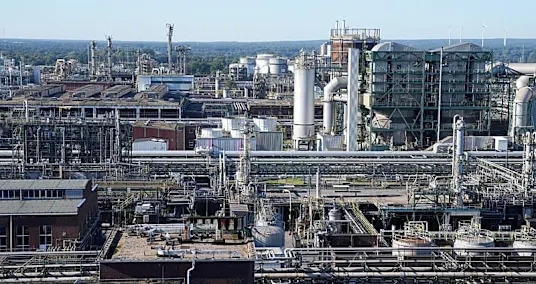
The Iran war is hitting the German economy at the worst possible time. Having only just fought its way out of a multi-year downturn, Europe's largest economy is now facing a new external shock — and the picture painted by leading researchers is one of structural exhaustion.
The country's top economic research institutes have more than halved their growth forecasts for 2026 in their Spring 2026 Joint Economic Forecast, published Wednesday.
The report, compiled twice a year on behalf of the Federal Ministry for Economic Affairs, draws on contributions from the German Institute for Economic Research (DIW Berlin), the Ifo Institute and the Kiel Institute for the World Economy, among others.
Iran war halves growth forecast
Where economists were still projecting growth of 1.3% to 1.4% last autumn, the institute now expects GDP to expand by just 0.6% this year and 0.9% in 2027.
Economic output effectively stalled in the first quarter, with the Bundesbank's March monthly report finding that real GDP likely stagnated on a seasonally adjusted basis in the first three months of the year.
"The energy price shock in the wake of the Iran war is hitting the recovery hard, but expansive fiscal policy is supporting the domestic economy and preventing a more severe downturn," said Timo Wollmershäuser, head of economic research at the ifo Institute.
Blocked shipping routes and disrupted energy markets are pushing up commodity and energy prices worldwide, with direct consequences for Germany's energy-intensive industry.
Related
-
This German village relies on renewables to avoid rising energy costs
-
Germany's first Omani LNG shipments arrive despite Middle East disruptions
Inflation on the rise
The price increases are feeding through to consumers. The institutes expect average annual inflation to reach 2.8% in 2026 and 2.9% in 2027.
The Bundesbank warns the rate could climb sharply towards 3% in the near term, driven primarily by higher fuel and heating oil prices.
Should the Strait of Hormuz — the central artery for global oil and LNG trade — remain blocked, upside risks to inflation could be greater still, directly weighing on private consumption that was supposed to anchor the domestic recovery.
While parts of the defence industry and civil engineering are benefiting from government spending, industry as a whole remains sluggish.
Exports are barely growing, held back by weak competitiveness, geopolitical uncertainty and trade policy headwinds.
The Bundesbank notes that low capacity utilisation is compounding the problem.
The chemical sector is bearing the sharpest pain. The Hormuz blockade is disrupting supply chains for raw materials that have no short-term substitutes.
latest_posts
- 1
 Air superiority and long-range strikes: what China's war games say about how it might assault Taiwan
- 2Brexit's Effect on New York's Ascent as a Main Monetary Center
- 3Israeli media reports Iran attacking greater Tel Aviv region
- 4'All's Fair,' Ryan Murphy's new show starring Kim Kardashian, hit with scathing reviews: 'A girlboss fever dream'
- 5From Amateur to Master: My Involvement in Photography




- Vote In favor of Your Favored Web-based Venture Stage
- How to watch the last supermoon of the year
- I spent the last year transforming my life. Becoming a Rockette for a day made me confront a fear I couldn't shake.
- Mummified cheetahs found in Saudi caves shed light on lost populations
- Traveling Alone: An Excursion of Self-Disclosure
- Underestimated Metropolitan Experience Urban communities On the planet
- Home Security Frameworks with Shrewd Elements
- ‘I love this work, but it’s killing me’: The unique toll of being a spiritual leader today
- Chinese construction workers in Israel: 'I’d rather be bombed than live in poverty'